
X’s ad repository still breaks DSA Article 39, seven months after the €120M fine
[UPDATE, 17 July 2026] On 16 July 2026 the European Commission accepted X’s action plan to bring its advertising repository and researcher data access into line with the DSA. X has committed to add API access and more ad information to the repository and to cut its response times, to give eligible researchers data free of charge through a streamlined application process, and to stop contractually barring the scraping of public data. It has six months to implement the changes, after which an independent auditor must report to the Commission. The Board for Digital Services called the plan only “partially adequate” and judged the audit measures “insufficient to address the infringements.”
None of it is fixed yet: a plan accepted is a promise of future compliance, not evidence of it. The findings below, from our test of the live repository on 12 July 2026, still stand. We are tracking the case, and X’s progress against its six-month deadline, on our DSA enforcement tracker.
On 5 December 2025 the European Commission fined X €120 million, its first non-compliance decision under the Digital Services Act. Part of that fine was for X’s advertising repository, which the Commission found breached Article 39 of the DSA: it was not meaningfully searchable, it was missing required data, and it was slowed by artificial delays.
X was given 90 working days to submit a plan to fix it. That deadline has passed. Rather than fix the repository, X filed an appeal at the EU General Court on 16 February 2026.
We went to X’s ad repository on 12 July 2026 and tested it against what Article 39 actually requires. Nothing has been fixed. On one measure it is worse.
What Article 39 requires
Article 39 says a very large platform that runs ads must keep a public repository that is searchable and reliable, supports queries on multiple criteria, and offers programmatic access. For every ad it must hold: the content of the ad, including the product, brand and subject matter; the person the ad was run on behalf of; the person who paid for it, where that is different; the period it ran; whether it was targeted and the main targeting parameters used; and the total number of people reached, broken down by member state.
What X actually provides
1. You cannot search by anything that matters
The only filters are advertiser account, country and date range. There is no way to search by ad content, by who paid, or by targeting parameters. The advertiser box only accepts an exact account handle, so you have to already know who you are looking for. You cannot discover a campaign you do not already know exists. That is the opposite of the multi-criteria search Article 39 requires.
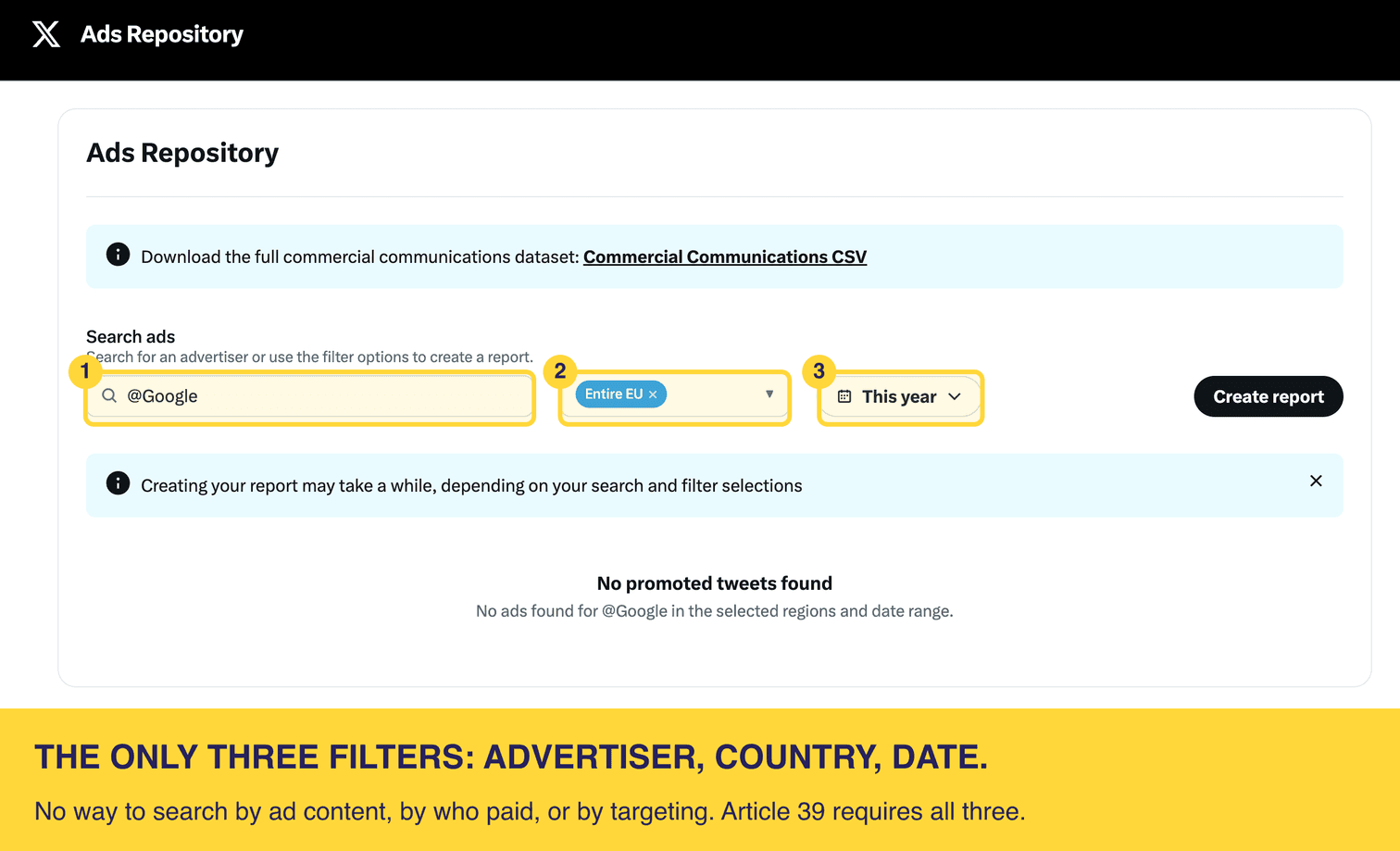
X’s ad repository, searched for @Google across the entire EU for 2026. The only filters are advertiser, country and date, and it returns nothing.
2. The data itself is almost empty
X offers a single bulk file, the “Commercial Communications” dataset, as its full record. That file has three columns: a date, a link to a tweet, and the tweet’s ID. That is all.
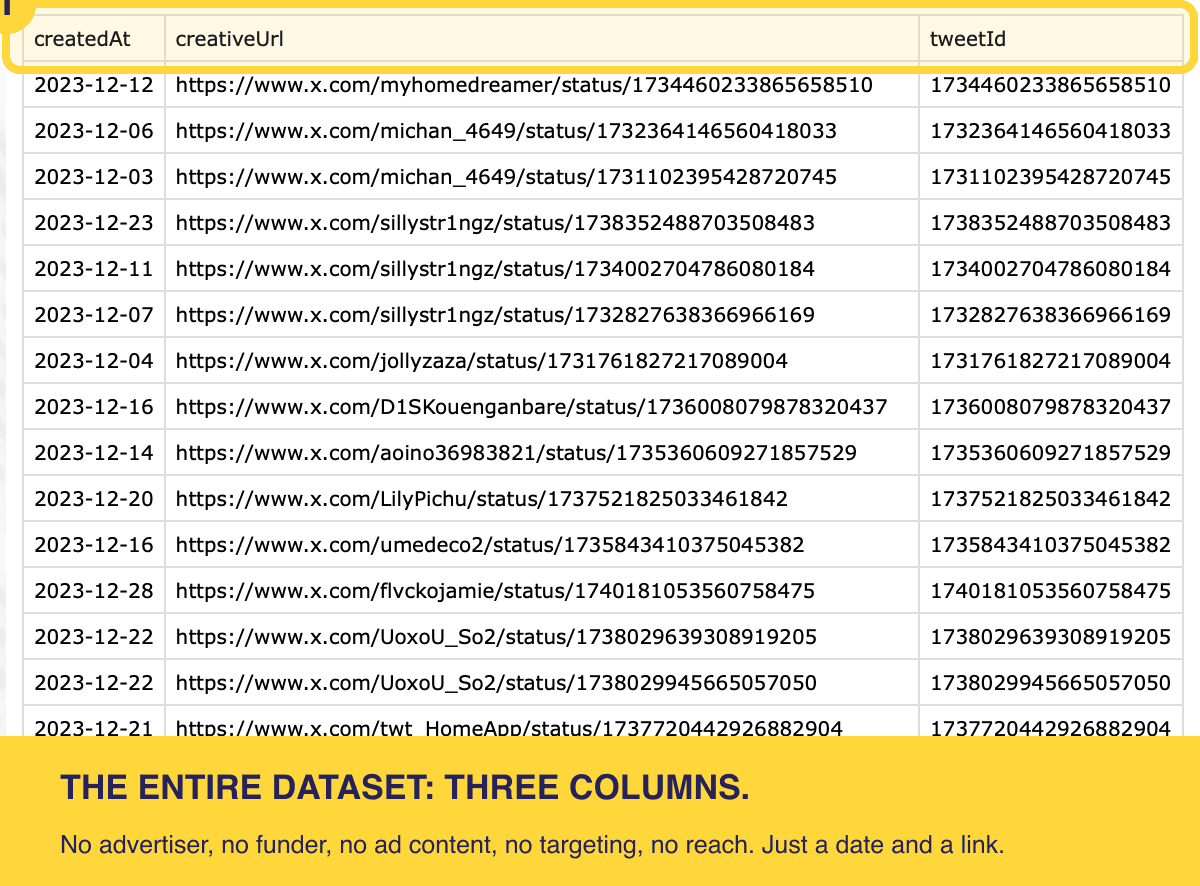
The full “Commercial Communications” dataset offered for download: three columns, and every row dated December 2023.
It does not contain the funder or paying entity, an advertiser field, the ad content or subject matter, any targeting information, or reach figures broken down by member state. Article 39 requires all of those. A date and a link is not an ad repository.
3. The tool is deliberately slow
In 2024 the Commission measured X inflating the repository’s response time to 3 minutes and 20 seconds. We ran two reports and timed each one from the moment we pressed “Create report” to the moment the download unlocked. One took 5 minutes and 2 seconds. The other took 5 minutes and 36 seconds. Both were for searches that returned zero ads, so there was no data to assemble. The delay is imposed, and it is now longer than when the Commission fined X for it.
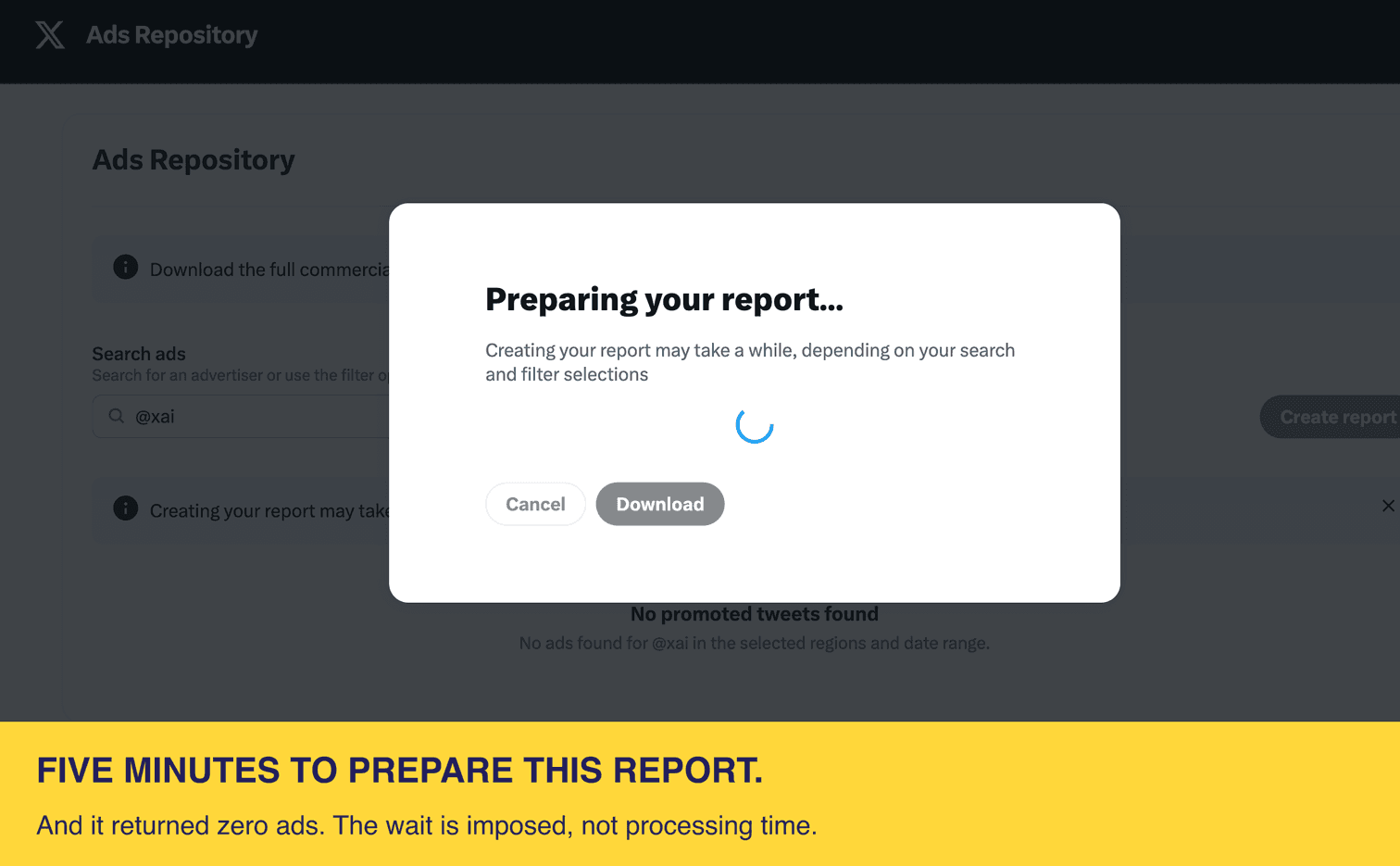
A report for @xai that returned no ads still took over five minutes to prepare.
4. The repository returns nothing for the current year
Every row in the bulk file is dated December 2023. The dataset appears frozen at launch. When we searched major advertisers across the entire EU for 2026, including Amazon, Google and Musk’s own xAI, the repository returned “No ads found” for all of them. A repository that holds no current ads for the largest advertisers on the platform is not the reliable, complete record Article 39 requires.
The bottom line
Seven months after being fined, and with the remediation deadline gone, X’s ad repository still fails Article 39 on every point the Commission raised. It is not searchable, it does not contain the required data, and it is slowed by artificial delays. On top of that, it appears to hold no ad data more recent than December 2023.
Methodology: we tested the live repository at ads.x.com/ads-repository on 12 July 2026. Response times were measured from a single connection and are reported as observed. The original findings are set out in the Commission’s decision of 5 December 2025.
Latest blog posts
View All July 20, 2026
TikTok's ad library, seven months into its DSA pledge: two fixes shipped, two still missing
The European Commission accepted TikTok's binding Digital Services Act commitments on ad transparency in December 2025. We tested the live Commercial Content Library in July 2026: full ad content and 24-hour updates are live, but the promised age-and-gender reach data and search filters are not.
 July 12, 2026
Why this transparency data only exists in the EU
The monthly-active-user counts, ad libraries and transparency reports behind this site all exist for one reason: the EU's Digital Services Act forces very large platforms to publish them. Here are the specific articles that make it possible — and why the same numbers don't exist anywhere else.
 June 26, 2026
What the Latest Round of DSA Transparency Reports Reveals (2025–26)
The latest EU DSA transparency reports are in: TikTok (178.3M EU users, July–Dec 2025), X (102M, Apr–Jun 2025) and Google/YouTube (Jan–Jun 2025). What the platforms reported, and why the numbers don't compare directly.
Check All Platforms' Compliance
TikTok: Compliance with the DSA
ViewFacebook: Compliance with the DSA
ViewInstagram: Compliance with the DSA
ViewYouTube: Compliance with the DSA
ViewGoogle: Compliance with the DSA
ViewX.com: Compliance with the DSA
ViewSnapchat: Compliance with the DSA
ViewLinkedIn: Compliance with the DSA
ViewAmazon: Compliance with the DSA
View